
Knowledge that changes is best placed in context and retrieved. Behavior that must remain constant is best placed in the weights and fine-tuned. All other things should first be attempted with prompting, as this is the cheapest thing to reverse if it fails.
Most errors in LLM customization are made before a single line of code is written. A diagnosis is made after the method has been attempted, not before. Fine-tuning, RAGs, and prompt engineering are not merely a list of methods of increasing sophistication that can be tried in turn. Instead, each solves a particular, distinct problem, and the following sections map each method to the problems they solve, and then provide the technical founder with a means to audit which problem their production system is experiencing.
Why the Fine-Tuning vs RAG vs Prompt Engineering Decision Matters More Than the Model You Pick
Knowledge that changes needs to be stored in context and retrieved. Behavior that needs to remain consistent needs to be stored in the weights and fine-tuned. All else should be attempted as prompting first is the cheapest way to reverse.
The hidden cost of choosing the wrong adaptation strategy
The choice among LLM customization strategies primarily determines cost, latency, and maintenance burden for your application and thus is a more crucial decision than selecting a base model.
Why most teams start with the hardest option first
There is a perverse prestige given to fine-tuning as the method to take to production for your LLMs. But LLM adaptation for business is an architectural decision with large long-term implications, and you can use all three methods in the end. Most production systems end up layering all three.
Prompt Engineering: The Fastest Path to a Working LLM Product
Start by fixing the instruction-following problems of prompt engineering, which can have fixes shipped in minutes without needing to retrain your model.
What prompt engineering actually controls (and what it cannot)
The prompt controls the perspective the model uses to complete a task and shapes the resulting response. It does not add new information that the model does not already know and is not effective for maintaining a tone across thousands of responses when the underlying model is resistant.
Techniques that move the needle: few-shot, chain-of-thought, system prompts
Few-shot prompting adds in labeled examples for behavior change, typically within the same data set as the prompt, without creating a new training data set. Additionally, prompting with a well-structured system prompt enables use of additional techniques such as few-shot prompting and Chain-of-thought prompting.
When prompt engineering alone is sufficient for production
Such a system works fine if the needed knowledge fits into the given context window and does not require strict output consistency. Once either of these 'boundary conditions' is not met anymore, the ceiling of this approach is reached and it is necessary to decide whether the gap is a problem of knowledge or of behavior.
Retrieval-Augmented Generation (RAG): Giving Your LLM Access to Live, Private Data
This is a missing-knowledge problem, not a behavior problem.
How RAG works: vector stores, embeddings, and retrieval pipelines
An RAG (Retrieval-Augmented Generation) system for documents first embeds documents in an embedding space using an embedding model, stores these embeddings in vector databases (e.g. Pinecone, pgvector), and then uses retrieval tools like LangChain or LlamaIndex to find the best chunks of text to complete with generation. The approach was introduced in the original RAG paper by Lewis et al.
Data freshness and source attribution
The knowledge base can be updated by re-indexing documents, without having to retrain the model. Understanding when to use RAG vs fine-tuning often comes down to this distinction: if the core problem is stale or private knowledge rather than a gap in reasoning style or task behavior, RAG is typically the more practical path.
RAG failure modes founders rarely anticipate
The failures occur when passage boundaries are poorly set so that related material ends up in separate passages, and the embeddings for a document fail to score highly so that the best documents at any retrieval depth are non-relevant documents. People misunderstand the issue of context-window overflow as they increase the number of documents injected into the system, not realizing that there is a point at which the answers simply cease to get better in a silent degradation of performance.
Fine-Tuning: When You Need the Model to Think and Sound Like Your Domain
Fine-tuning updates model weights directly, making it suitable for problems that persist despite changes to input prompts.
Supervised Fine-Tuning vs. RLHF vs. Parameter-Efficient Methods (LoRA, QLoRA)
Supervised fine-tuning of a model can be trained on labeled input-output data pairs. LoRA fine-tuning and QLoRA reduce memory usage and make it possible to use smaller GPUs by training only low-rank adapter matrices.
What Fine-Tuning Actually Changes Inside the Model
By shifting weight distributions rather than adding to a knowledge store, a domain-specific LLM fine-tuned in this way learns to reproduce a given tone and to follow a particular output format but does not learn to reproduce new information it has been trained on as factual memory.
The Data Requirements That Kill Most Fine-Tuning Projects Before They Start
As for the number of examples that are required to handle a change in domain, in practice, it always holds that all examples need to be re-curated, the model needs to be re-trained, and deployed again. In other words, the biggest cost of supervised fine-tuning is the maintenance burden. The workflow and its constraints are documented in the OpenAI fine-tuning guide.
The Decision Framework: Which Approach Fits Your Situation
Knowledge that changes often should be stored in context and retrieved. Behavior that needs to be consistent should be stored in the weights and fine-tuned. Everything else should be tried as prompting first.
The Three Questions Every CTO Should Answer Before Choosing a Strategy
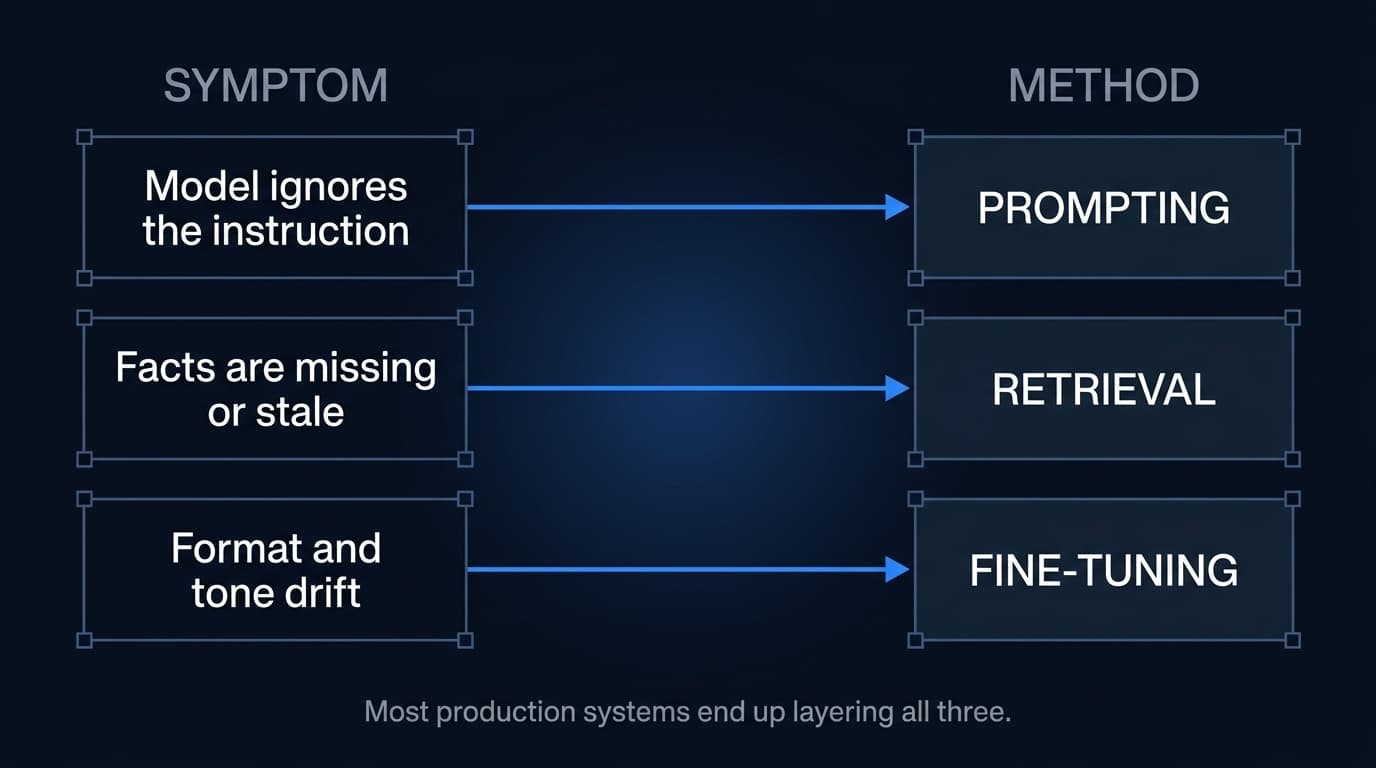
When deciding whether to use LLMs for decision making, first try to determine how often the knowledge base changes. Will the user need to know the source of a given output? How many labeled examples are there for the task at hand?
Scenario Mapping: Support Bots, Internal Search, Code Generation, and Document Drafting
A support bot for a dynamic FAQ is a RAG job. Legal document drafting in a home grown style is fine-tuning. An assistant for this sprint of work is prompt engineering, the cheapest thing to undo when it turns out requirements have changed.
When to Combine Fine-Tuning and RAG in a Single Pipeline
The best practice for domain-specific accuracy is found in Hybrid RAG fine-tuning pipelines. An assistant for code generation can be fine-tuned on a proprietary codebase to enforce a specific house style, and then searched against internal documentation using an RAG to ground responses in facts.
How to Build Your LLM Adaptation Stack: A Practical Starting Point for Technical Teams
Follow a sequence of prompt development, retrieval, and fine-tuning of a large language model (if there is a measurable gap remaining after the first two stages).
Phase 1, Prompt Engineering Baseline: Tools and Evaluation Setup
Track prompt versions with corresponding runs on the eval dataset to have a numeric accuracy score to make every subsequent decision (around prompt tweaking) measurable rather than just feeling one way or the other.
Phase 2, Adding RAG: Choosing a Vector Store and Chunking Strategy
Setting up a RAG stack first begins with finding the right infrastructure. pgvector is ready-to-use with most PostgreSQL deployments. Chunking semantic segments on paragraph boundaries typically performs better than splitting into fixed tokens.
Phase 3, Fine-Tuning: Data Curation, Training, and Regression Testing
Start a Llama fine-tuning experiment only after you have established a clear and persistent performance gap after Phases 1 and 2. For that fine-tuning use an open-weight LLM (e.g. Llama 3, Mistral) and apply LoRA or QLoRA for fine-tuning, and then re-run the full eval suite for the fine-tuned model: frequently your new training will cause general instruction-following performance to degrade even as score on target task increases.
Choosing the Right LLM Strategy for Your Project: Next Steps
How to audit your current LLM setup against this framework
Map the failures in your eval set to the three root causes of problems (missing knowledge, incoherent behavior, failure to follow instructions) and then address each accordingly.
FAQ
What is the difference between fine-tuning vs RAG vs prompt engineering for LLMs?
There is a significant difference in cost and complexity for Prompt Engineering (which shapes model behavior via carefully engineered prompts without changing the model itself), using RAG (which connects a model to the latest version of data at inference time) and Fine-Tuning (which re-trains a model's weights on domain specific data, such as examples and tasks).
When should a startup use RAG instead of fine-tuning?
Since fine-tuned models can't be updated for changed underlying data (e.g. product catalogs, support articles, internal knowledge bases) faster than RAG, the latter is generally the better approach for such cases. Additionally, RAG requires significantly less compute and can be set up much faster than fine-tuning. It is only worthwhile if consistent tone, reasonable structure, and very specialized vocabulary for high volumes of input is more important than up-to-date data.
Is prompt engineering enough for enterprise LLM use cases?
In early-stage applications, prompt engineering for enterprise LLMs often performs surprisingly well and with little infrastructure needed. As you need to have proprietary knowledge encoded in the model that the base model was never trained on, or you need consistent formatting and domain-specific accuracy at scale, you will likely need to add RAG or fine-tuning to prompt engineering.